Loading... Please wait...




















Recent Posts
Airsoft CQB Tips & Tactics
Posted by on
How to Dominate in Airsoft CQB: Become a Specialist Room Breacher
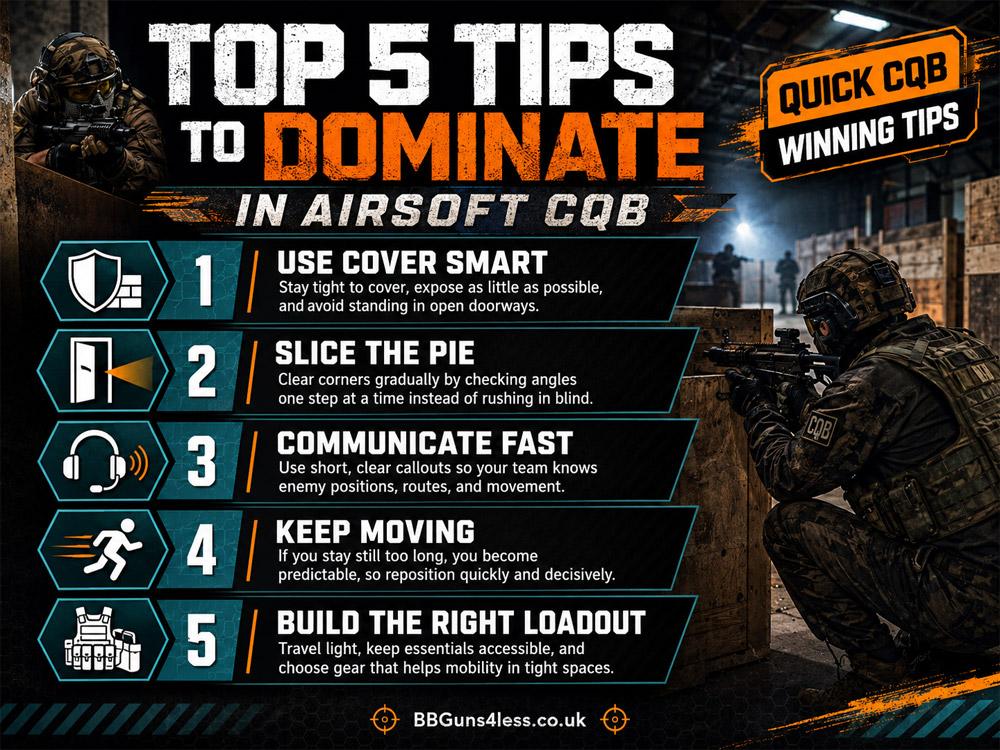
Indoor CQB airsoft is where games are won or lost in seconds. If you want to consistently beat airsoft rivals in tight, fast-paced conditions, you need more than a fast trigger finger. You need proper CQB tactics, deliberate practice, and the readiness to lead when everyone else hesitates at the doorway.
This airsoft guide breaks down exactly how to become a expert room breacher, covering everything from mindset and techniques to loadout choices and drills you can run in your own home.
Key Takeaways
-
Dominating close quarters combat in airsoft games depends far more on mindset, movement, and decision making than on expensive gear. Airsoft players who stay calm, read rooms quickly, and commit to entries without hesitation consistently outperform those relying on firepower alone.
-
Specialist room breachers win by mastering slice-the-pie, clean room entries, and deliberate use of angles and cover to control close quarters environments. These core principles separate reliable point men from players who simply rush and trade hits.
-
Focused CQB training at home-dry runs with unloaded replicas, shot-timer apps, and decision-making drills-massively accelerates progress between game days. Even 10–15 minutes of daily practice compounds into hours of extra training each month.
-
Choosing the right airsoft guns and loadout (short platform, fast optic, light rig, strong protection) supports your cqb skills but never replaces them. Technique first, gear second.
Understanding Close Quarters Combat in Airsoft
Close quarters combat in airsoft refers to engagements inside built structures, dense urban terrain, or indoor arenas where distances are typically under 10–20 meters. Rounds are fast, decision making is constant, and the player who controls confined spaces wins. CQB stands for Close Quarters Battle, and it involves combat in confined spaces like rooms and hallways. CQB engagements typically occur within 30 meters, making spatial awareness and reaction time far more valuable than long-range accuracy.
In the real world, CQB is crucial for military and law enforcement operations. Military CQB emphasises rapid neutralisation of combatants, while police CQB focuses on protecting civilians and preserving evidence. SWAT teams commonly use CQB tactics for high-risk incidents such as hostage rescue. CQB often occurs in urban areas like buildings and ships. In airsoft games, we adapt these tactical operations for competitive play with specific safety rules, fps limits, and non-lethal force.
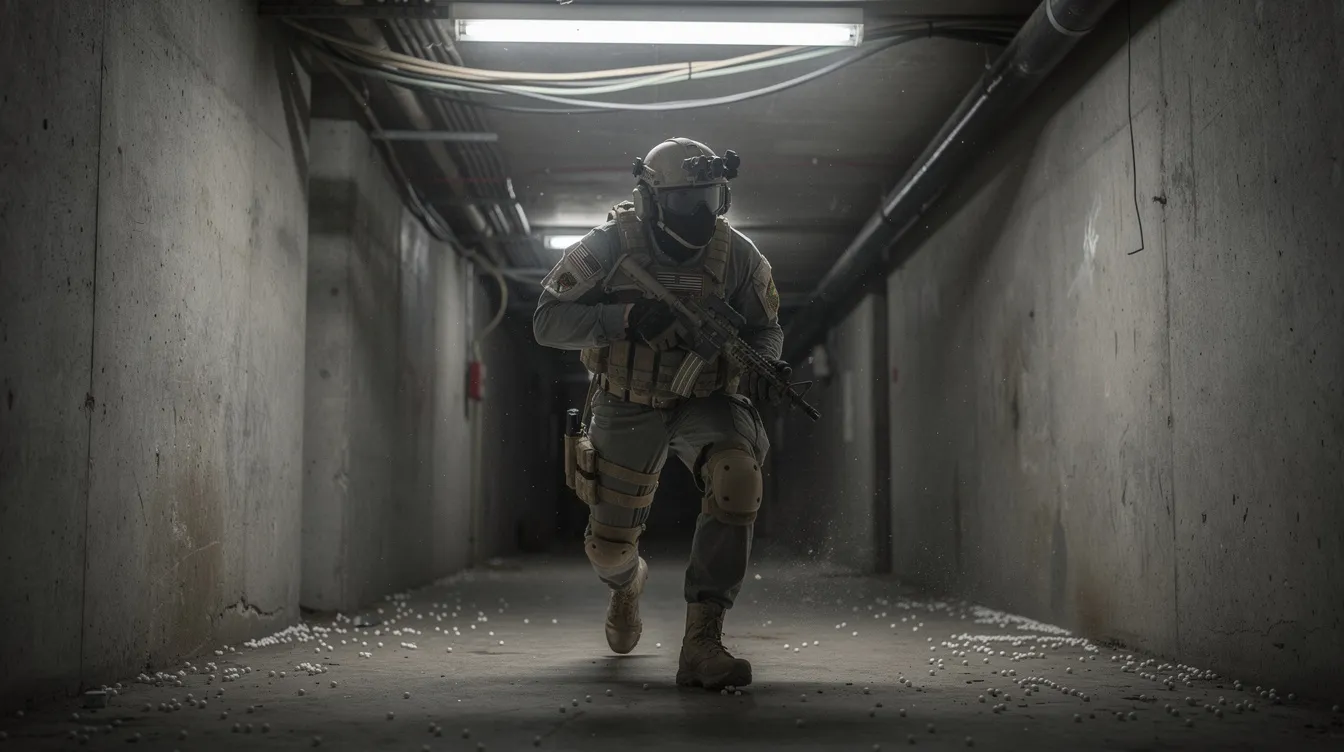
Common CQB environments include UK-style single-level kill houses, US warehouse fields, and mixed indoor-outdoor compounds that have increased since roughly 2010. These training environments feature tight corners, stairwells, and narrow corridors that shape every tactical decision. Room breaching is the decisive moment in most CQB operations: you leave cover, enter the fatal funnel, and must dominate the space faster than defenders can react. CQB principles include speed, surprise, and violence of action-and understanding these core CQB principles is where your journey starts.
What Makes a Great CQB Player?
Inexperienced airsoft players rush blindly into rooms, tunnel-vision onto one threat, and spray BBs from their airsoft gun hoping for kills. Effective CQB specialists look completely different: calm under sudden violence, methodical in their approach, and maintaining a high survival rate across a full day of games. CQB requires split-second decision-making to identify targets and avoid friendly fire, and the airsoft players who excel at this consistently outperform everyone else.
Concrete traits of top performers include:
-
Composure under sudden close quarters contact at close range
-
Fast but disciplined decision making when choosing lines of sight and entry timing
-
Willingness to lead a breach and take decisive action in unclear team situations
-
Room-reading ability that lets them anticipate defender positions before committing
Key CQB skills that separate experienced airsofters from average players include angle management, smooth movement in tight spaces, consistent use of slice-the-pie, clean entries, and clear communication with ad hoc teams on public skirmish days. Limited visibility and compressed reaction times are distinctive challenges of CQB, which means individual skills like quick target acquisition matter enormously.
Repeatable performance over a whole day matters more than one flashy rush. Good CQB players conserve energy, avoid unnecessary trades, and stay effective from first to last game.
Choosing the Right Airsoft guns for CQB
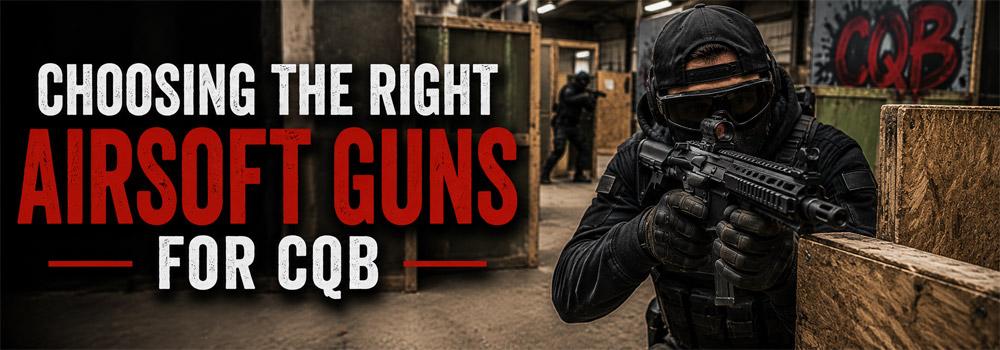
CQB gear will not fix bad CQB techniques, but the wrong gear can slow you down or make tight angles and room entries significantly harder.
Primary Airsoft guns: compact carbines and short-barrel airsoft rifles are ideal for CQB. Look at compact AEGs and submachine guns-ARP9, MP5K, short-barrel M4 builds around 7–10.5 inches. Short-barreled rifles and compact firearms give you the manoeuvrability that matters in tight spaces. Research on firearms in confined spaces confirms that barrel length under roughly 10 inches retains manoeuvrability while allowing quicker transitions between sectors. Tune to field fps limits, typically 280–350 FPS for 0.20g BBs at indoor venues.
Airsoft Sidearms: A good pistol for an airsoft CQB match should be compact, reliable, and easy to use in tight spaces. Gas blowback pistols are a popular choice because they offer realistic recoil, quick follow-up shots, and strong performance at short range. Models based on the Hi-Capa, Glock, or SIG platforms are widely supported, so magazines, holsters, and replacement parts are easy to find. For indoor matches, look for a pistol with an adjustable hop-up, a comfortable grip, and a power level that stays within the site’s FPS limits.
Airsoft players who value consistency may prefer a non-blowback gas pistol or an electric airsoft pistol. Non-blowback models usually use less gas and can perform well in cooler conditions, while electric pistols are simple to operate and offer semi-automatic or fully automatic fire on some models. Whichever type you choose, reliability is more important than appearance. Test the pistol before the match, carry at least one spare magazine, and use a secure holster that fully covers the trigger area.
Optics and accessories: red-dot optics enhance target acquisition in close quarters; non-magnified dots are the standard. Offset irons or fiber sights provide backup. Weapon-mounted lights and weapon lights help in low-light fields where permitted. Avoid bulky magnified scopes and long bipods-they're a liability in close quarters battle.
Airsoft pyrotechnics and grenades: can be useful in CQB for clearing rooms, breaking up groups, or forcing opponents away from cover. A timed or impact grenade can create a brief distraction before your team enters, while smoke can block sightlines and help players move between positions. Always communicate with teammates before using one so nobody rushes into the area unexpectedly. use grenades as part of a coordinated push rather than relying on them alone.
Protection: full-face or lower-face plus eye protection is mandatory. Padded gloves, knee pads for low-angle fighting, a lightweight chest rig over a heavy plate carrier, and firm-ankle footwear for grippy indoor floors complete the setup. Private security professionals and law enforcement follow similar principles: mobility and protection balanced for CQB situations.
Build the Right Mindset for Close Quarters Battle
Close quarters battle cqb punishes ego and impatience. The primary difference between a reckless rusher and a room breacher specialist is mindset, not reflexes.
Adopt a problem-solver mentality. Treat each room and corridor as a puzzle in geometry, timing, and close combat decision-making rather than just a place to trade BBs. CQB emphasizes controlling confined spaces rapidly and decisively-your job is to solve each space before you enter it.
Develop a "threat-first" mindset: constantly ask "where can someone shoot me from in the next three seconds?" and update that mental map every step. Situational awareness involves continuously observing potential threats and risks. Speed means there's no gap between decision and action. Research on CQB training effectiveness defines this as "prioritisation and risk potentials"-the theoretical foundation that drives smarter movement.
Mental resilience matters too. Accept that you will get hit frequently while learning. Every hit is a data point: bad angle, poor cover use, telegraphed barrel. Keeping a simple post-game journal to track recurring mistakes accelerates improvement dramatically.
Finally, maintain an ethical and safety mindset. Respect minimum engagement distances, blind-fire rules, and field-specific regulations introduced widely around 2015–2020 to keep tight indoor games safe in hostile environments.
Master Movement in Tight CQB Environments
Movement is the language of close quarters combat. How you move telegraphs your confidence, intent, and sometimes your exact position through sound. Rapid movement between cover points is essential, but uncontrolled sprinting in tight quarters gets you eliminated.
Core movement principles for cqb environments:
-
Stay off the centerline of hallways to reduce exposure to both sides
-
Keep distance from corners to expand your viewing angle before committing
-
Never silhouette yourself in doorways or windows-silhouette equals target
-
Maintain awareness of vertical angles: stairs, lofts, and overhead beams can expose your head and torso
Specific movement techniques include heel-to-toe or ball-of-foot quiet steps for controlled approaches, keeping your weapon close to your body when moving fast versus extended when "on the gun," and using short, controlled bursts of speed between pieces of cover. CQB uniforms and gear should prioritise mobility and protection in confined spaces, so everything you wear should support rapid movement without snagging on door frames.
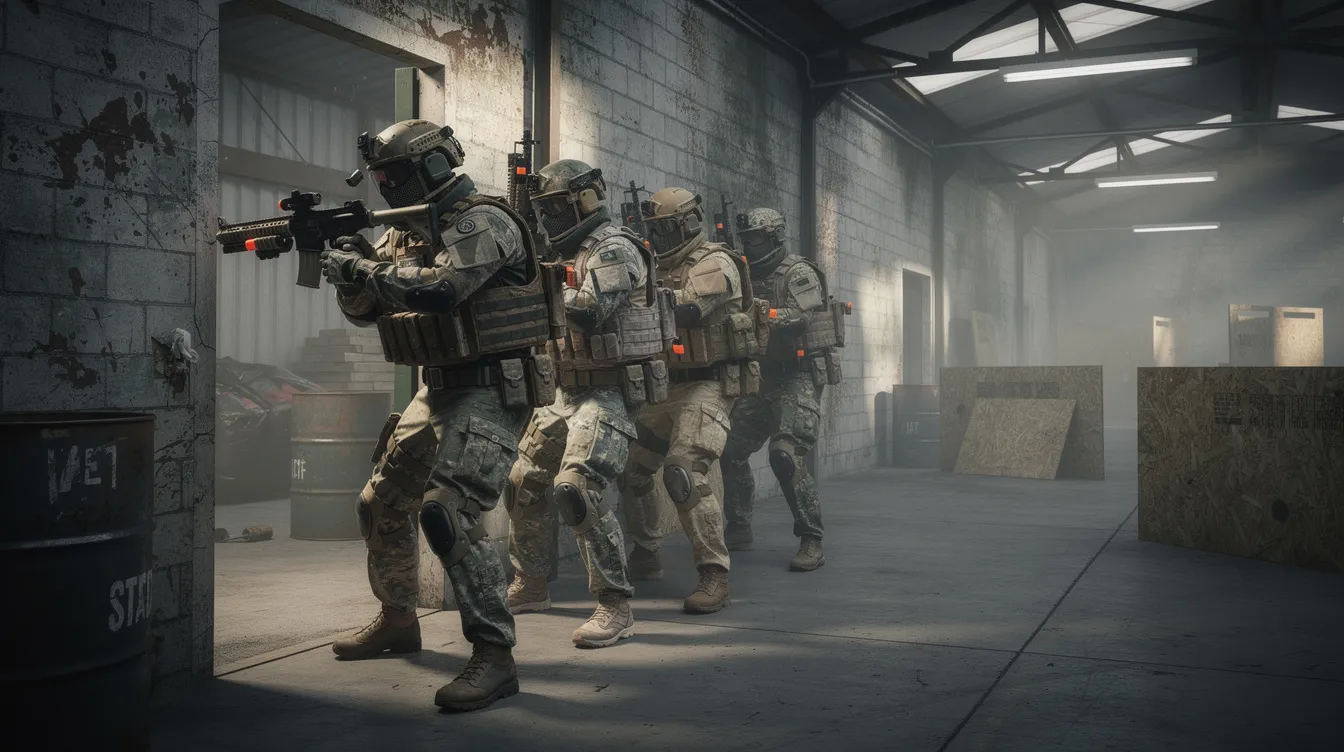
For team movement during cqb operations, maintain single-file stacks near doors, staggered positions in corridors, and give each player a defined sector to prevent overlapping fire and friendly hits. Team coordination during movement is what separates a tactical team from a crowd of individuals bumping into each other.
During full-day indoor events with 3–4 minute rounds every 10 minutes, manage fatigue through pacing, hydration, and walking pace between pushes so you can still explode into a room when needed.
Learn to Slice the Pie Like a Specialist
Slicing the pie is a key room clearing technique and arguably the single most important CQB technique for room breakers and solo players. It's the foundation of nearly all common CQB tactics used by both military personnel and airsoft competitors.
The core principle is simple: stand back from the doorway or corner and expose tiny slivers of the room at a time, letting your muzzle and eyes arrive together instead of swinging your whole body in at once.
Concrete technique steps:
-
Maintain roughly an arm's length or more from the threshold-this maximizes how much room you can see per degree of exposure
-
Shift your weight in small lateral increments, scanning bottom to top in each new "slice"
-
Keep your gun close to cover until you're ready to commit to a shot
-
Never lean your head out before your barrel and eye line are aligned
Prioritise slice-the-pie over rapid dynamic entry when you're solo clearing, facing an unknown number of opponents, working multi-door rooms, or when defenders are likely pre-aiming the fatal funnel. This is one of the common CQB tactics that works equally well for special operations forces and weekend airsoft players.
At-home drill: mark a "door" with tape on a wall, place a few paper targets inside the room, and practice slow slice-the-pie with focus on foot placement and muzzle alignment. Use a shot-timer phone app to gradually balance speed against careful angle work.
Entering Rooms Without Dying in the Fatal Funnel
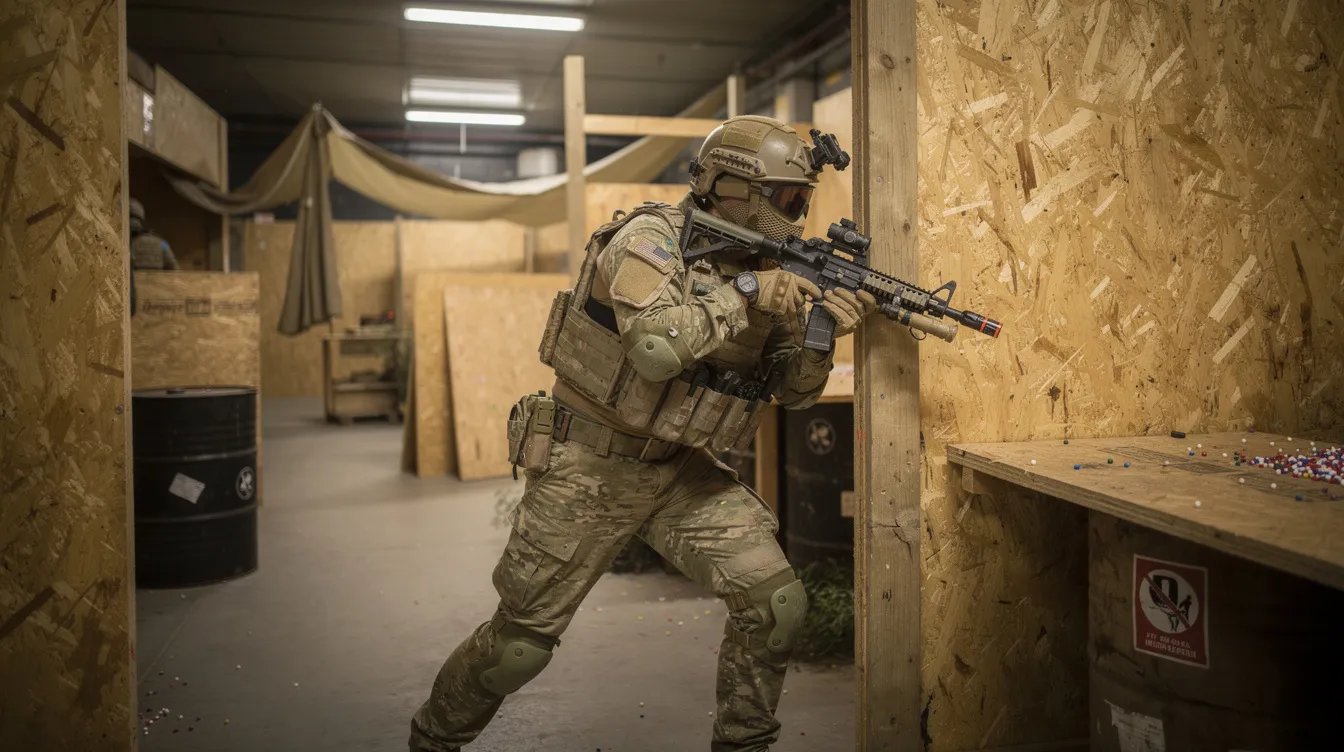
The Fatal Funnel is a high-threat zone at a doorway or entrance where all defender attention and BBs naturally concentrate. Every entry point in a CQB field is a potential death trap if you handle it wrong.
Solo entry sequence:
-
Slice-the-pie until you've seen as much of the room as possible
-
Threshold Assessment involves assessing a room through a doorway before entering-do this before committing
-
Choose your entry side (left or right), then commit fully without stutter steps. Violence of action requires committing fully to movement
-
Move immediately to a piece of cover or a hard corner inside
Room clearing techniques include deliberate and dynamic clears. For airsoft teams, two simple options work well:
-
Limited penetration: stay just inside the doorway, holding corners with minimal exposure
-
Deep penetration: cross the room quickly to split defender focus using overwhelming force
For 2-man entries, the first player drives to the far corner while the second takes the near corner. In 3–4-man team entries, trailing players secure the center, door, and any secondary doors or stairwells. Actionable rules for home defense and airsoft alike include avoiding solo room clearing when you have teammates available and establishing hard corners as default positions. The assault team should practice various breaching techniques during cqb training to build fluency.
Training tip: run "no-shot" entries at home or at the field before games using unloaded replicas to drill footwork, then add targets and time pressure once the movement pattern is smooth.
Communication in Close Quarters Battle
In noisy, echoing cqb environments, simple pre-agreed words beat long explanations or shouting. Communication is vital in CQB, requiring clear coordination among team members. CQB emphasizes teamwork and quick decision-making under pressure, and clear comms are the glue holding a tactical team together.
Essential verbal callouts for close quarters:
|
Callout |
Meaning |
|---|---|
|
"Contact front/left/right" |
Enemy spotted in that direction |
|
"Crossing" |
Moving across a doorway or opening |
|
"Reloading" |
Temporarily unable to fire |
|
"Last man" |
Final player entering the stack |
|
"Stack on me" |
Form up at this position |
|
"Room clear" |
No threats remaining |
CQB environments demand high precision due to the presence of civilians or allies-in airsoft terms, friendly fire on teammates is a real problem solved by communication.
Non-verbal options include tap signals on shoulders in the stack, pointing for direction, and simple hand signs for "you go," "hold," or "two enemies." These work even with mesh masks and loud fans running.
On walk-on days with strangers, introduce a 2–3 callout vocabulary in the safe zone, keep language friendly, and assign quick roles like "you're number two in the stack." Even minimal coordination with security teams of random players gives you an advantage over uncoordinated opponents.
Using Angles and Cover to Dominate Close Quarters
Close quarters combat is mostly a geometry problem. Whoever shows less of themselves while seeing more of the opponent usually wins. This applies to both military operations and Saturday afternoon airsoft.
Understand vertical and horizontal angles: head-height versus low crouch peeks, using off-angles rather than standing square-on, and how stepping 30–50 centimeters sideways can completely change who can see whom. In real-world cqb military applications, specialized units train extensively on angle work-you can apply the same concepts in urban environments on your local field.
Differentiate real cover from concealment. In airsoft CQB, drums, wooden barricades, and brick corners stop BBs. Mesh fences and thin plywood only hide you visually. Ballistic shields increase survivability but reduce mobility-in airsoft, solid cover serves the same purpose without the weight. Adapt your positioning to what actually stops rounds.
Practical angle tactics include:
-
Headbox peeks showing only goggles and muzzle
-
Pre-aimed corners where you expect movement for quick target acquisition
-
Offset shooting positions that keep your gun from flagging the wall
Walk empty rooms between games. Map likely defender positions, lines of fire, and how to break those lines using door frames, stair rails, and furniture as improvised cover in urban warfare scenarios.
Common Beginner Mistakes in CQB and How to Avoid Them
Many close quarters mistakes repeat across every indoor field. Learning to spot and eliminate them is the fastest way to improve your individual skills.
Common errors and fixes:
|
Mistake |
Why It's Dangerous |
Fix |
|---|---|---|
|
Walking center of corridors |
Exposed to both sides simultaneously |
Hug one wall |
|
Stopping in doorways |
Pre-aimed defenders in the fatal funnel |
Count "one-two-three" and move through |
|
Leading with barrel around corners |
Warns opponents before you can see them |
Keep muzzle tight to cover until you commit |
|
Tunnel vision on one threat |
Flanks and vertical threats go unnoticed |
Short "scan-and-breathe" checks after each engagement |
|
Constant shouting |
Gives away position, adds cognitive load |
Use brief callouts only |
Target discrimination suffers when you're tunnel-visioned-you need to engage targets accurately while maintaining awareness of the broader space. CQB requires split-second judgment, and narrowing your attention to one corner while ignoring everything else is how you get eliminated from behind.
Psychological mistakes matter too: chasing kills instead of objectives, arguing hit-calls mid-game, and refusing to slow down between rounds to review what actually went wrong. Private security and special forces trainers would tell you the same thing-after-action reviews drive improvement.
Advanced CQB Tips for Specialist Room Breachers
This section is for players who already use slice-the-pie, basic entries, and clean comms and want to truly specialise as breachers. These are the CQB concepts that separate good players from dominant ones.
Timing and misdirection: surprise disrupts the opponent's rhythm with unexpected actions. Fake retreats followed by re-entries from unexpected directions, coordinating double-breaches from two doors when field rules allow, and using grenades or distraction devices to force defenders to look away from the main entrance all exploit this principle. Various breaching techniques-including ballistic breaching in real-world contexts and scenario-based training with mechanical rams and pry tools-all build from this same idea of creating opportunities through disruption.
Sound reading: track enemy reloads, gear rattles, and muffled footsteps through thin walls in cqb environments. Adjust your breaching time to hit just after they move or shout. Immediate action drills are used for surprise contact-practice snapping into your breach sequence the moment you hear unexpected movement.
Angle stacking and baiting: one teammate draws attention with noisy shots while you enter from a secondary angle, or use a quick shoulder peek to force opponents into pre-aiming one side before you breach on the other. Practitioner guides call this exploiting the "disadvantage curve" that defenders hold over attackers.
Build a playbook: keep 3–4 go-to breaching options for common room shapes at your local field. Rehearse them with your squad in modular shoot houses or controlled environments so everyone knows their sector the moment "breach" is called. Force-on-force training using low-lethality rounds can simulate the stress of real entries-in airsoft, every game day is force-on-force by default.
Practice Drills You Can Run at Home
Consistent home practice with an unloaded replica dramatically improves movement, slice-the-pie, and room entry skills between airsoft game days. Proper CQB training doesn't require training facilities-your hallway works. CQB training includes live-fire exercises in shoot houses for professionals, but airsoft players can replicate the movement patterns at home. Shoot houses allow teams to practice room clearing techniques, and your apartment corridor is a miniature version.
Dry-fire corner drill: mark a "door" with tape, place a few paper targets on walls, and practice slow slice-the-pie with focus on foot placement, muzzle alignment, and not flagging the wall. Use a mirror or phone camera to check your exposure. Practice room clearing drills until they feel automatic.
Shot-timer drill: draw from low ready on a random beep from a phone app, take one accurate "shot" on a marked target around a corner, and record time and consistency across 10–20 reps. Trainees practice various breaching techniques during CQB training cycle between button-hook and cross-entry patterns.
Decision-making drill: have a friend randomly label targets as "threat" or "no-shoot," call out which ones are active while you're facing away, then turn, process, and neutralise threats on the correct targets under mild time pressure. This builds target discrimination under stress.
CQB training includes metrics and after-action reviews for improvement-track your times, note your errors, and set specific goals for each practice session. CQB training emphasises speed, surprise, and violence of action, and your home drills should progressively incorporate all three as you improve.
Safety note: ensure replicas are unloaded and cleared, use eye protection if dry-firing, and never conduct drills outdoors where neighbors might mistake replicas for real firearms.
Putting It All Together: Becoming a True CQB Specialist
The journey from basic CQB skills to reliable room breaker follows a clear path: mindset, movement, angles, communication, and deliberate practice. Every section in this guide builds on the last.
Build a simple personal training plan:
-
Weeknights: one or two at-home close quarters drills (15 minutes each)
-
Game days: set one focused objective per session (e.g., "today I won't stop in doorways" or "today I practice room clearing drills before every entry")
-
Post-game: spend five minutes noting what worked and what broke down
Track progress over months. Note specific CQB environments where you now feel confident, rooms you previously feared to breach, and how often you survive first contact after entry. Combat zones in airsoft CQB get less intimidating as your skills compound.
Here's the truth that should motivate you: most opponents never formalise their CQB training. Special forces and law enforcement units invest hundreds of hours in immediate action drills and scenario-based training because deliberate practice works. A player who applies even a fraction of that discipline to airsoft will quickly stand out as the go-to room breacher on any field, whether they're running with CQB teams of regulars or walking on with strangers.
Start with one drill this week. Set one objective for your next game. The results will follow.
FAQ
These questions cover extra ground about airsoft CQB and room breaching that the main sections don't fully address.
What's a good way to start CQB if my local field is mostly woodland?
You can borrow indoor CQB concepts for outdoor close quarters play. Use trees and bunkers as "door frames," practice slice-the-pie on corners of buildings or barricades, and play tight around objectives where ranges drop under 20 meters. The same movement techniques-quiet steps, angle management, not silhouetting yourself-apply in woodland close-proximity engagements around structures.
Visit dedicated CQB environments a few times per year (indoor arenas, mixed urban sites) to stress-test your skills under real pressure, then import those lessons back into woodland play. Even one or two sessions in a proper kill house will sharpen instincts you can't develop in open terrain.
How much room breaching gear do I really need for airsoft CQB?
In airsoft CQB, specialist breachers don't need real breaching tools like the tools used by law enforcement. Focus instead on a compact Submachine gun primary, and a reliable GBB Pistol sidearm, a comfortable chest rig, and solid eye and face protection. Melee weapons are almost never relevant in airsoft CQB despite their close combat heritage from world war ii and earlier conflicts.
Optional items that help include a small sling-mounted flashlight if field rules permit, lighter gloves for better trigger feel in close quarters, and a low-profile bump cap for overhead obstacles in tight quarters. Keep it light-heavy loadouts slow you down in CQB situations where speed wins.
Can I practice CQB techniques in a small apartment? Is it worth it?
Even in a tight flat, you can safely rehearse movement, angles, and slice-the-pie using narrow corridors and doorways. Ensure replicas are cleared, windows are covered to avoid alarming neighbours, and you're wearing eye protection during any dry-fire practice.
Ten to fifteen minutes of focused daily practice in a small space adds up to hours of extra CQB training each month. You'll develop smoother entries, faster decision-making, and better spatial awareness on game day. Hand-to-hand combat drills and weapon transitions also benefit from confined-space repetition-your apartment is a functional training facility for close-quarters environments.
How do I handle players who don't communicate or follow CQB tactics?
Volunteer to be point man. Use 2–3 basic callouts that less experienced players can copy immediately. Briefly explain your plan in the safe zone before the round starts rather than mid-fight-nobody absorbs lectures while BBs are flying in close proximity.
Focus on what you can control: your own angles, cover use, and slice-the-pie execution. Treat less disciplined teammates as moving cover rather than reliable close quarters partners. Sudden violence in airsoft CQB is easier to handle when you've already accepted that you might be operating with an unreliable assault team rather than a coordinated tactical unit with specialised units trained together.
Is it better to specialise in CQB or be a generalist airsoft player?
Specialising in close quarters combat makes you extremely valuable on indoor and urban sites where most players hesitate to breach. You become the person that CQB teams want at the front of every stack. In hostile environments like multi-story kill houses, a trained breacher changes outcomes for entire squads.
A balanced approach works best long-term: build a strong CQB core-movement, room breaching, angles-first- then expand into longer-range roles. Once you're comfortable leading entries and operating in confined spaces, your spatial awareness and decision-making will transfer into woodland and open-field play as well.