Loading... Please wait...


















Categories
Price
Types of P90 Airsoft Guns
P90 airsoft models split along two axes: power system (AEG or gas blowback) and build tier (budget through premium). Each combination changes reliability, realism, and cost.
AEG P90 Models
AEG P90s run on an electric motor and gearbox powered by a rechargeable battery. They deliver consistent velocity regardless of ambient temperature, require less maintenance than gas alternatives, and cost less per shot. Most players, from beginners to experienced competitors, choose AEGs for field reliability.
The Tokyo Marui P90 Standard Type set the template: a Version 6 gearbox, 68-round translucent magazine with dummy 5.7mm cartridges, and an overall length of 504 mm at roughly 2,200 g. It shoots around 260 to 280 fps with the stock spring. The Krytac EMG FN P90 Custom Edition sits at the premium end, delivering 380 to 400 fps (about 1.49 Joules with 0.20 g BBs), a fire rate above 20 rounds per second on an 11.1 V battery, and a selectable 50/200-round magazine. The Novritsch SSR90 Gen2 pushes fire rate to roughly 25 RPS, ships with a 100-round magazine, weighs 1.9 kg, and uses a precision 6.03 mm inner barrel with a CNC hop-up unit.
Gas Blowback P90 Models
Gas blowback P90s simulate realistic cycling: the bolt reciprocates with each shot, producing audible report and physical recoil absent from AEGs. The WE / Cybergun licensed FN P90 GBBRis currently the only licensed gas blowback P90 available. Users value the tactile feedback for semi automatic fire drills and milsim immersion.
The trade-offs are concrete. Gas pressure drops in cold weather, reducing velocity and cycling reliability. Magazines are more expensive and prone to seal leaks at the valve or gas router. User reports consistently cite heavy trigger pull in semi automatic mode, feeding issues, and fragile internal components. Field velocity often exceeds CQB limits (around 1.9 Joules), requiring spring or valve modifications before play.
Budget vs Premium P90s
Entry-level P90 rifles like the JG D90 and generic clones cost under £150. They use polymer bodies, basic gearboxes with lower-grade gears, and simplified hop-up units. Out-of-box FPS tends to be low, and magazine fit can be inconsistent. These guns work as starter platforms or backup weapons but typically need internal upgrades for competitive reliability.
Mid-range models from King Arms or CYMA (Cybergun licensed) sit between £200 and £300 and offer improved internals, licensed FN Herstal markings, and better tolerances. Premium options above £450, such as the Krytac Custom Edition, include aluminium receivers, electronic trigger units (ETUs) with pre-cocking and burst modes, steel gearbox components, and precision 6.03 to 6.05 mm inner barrels.
What to Look For in P90 Airsoft Guns
Three attributes separate a P90 SMG that performs on your airsoft game day from one that frustrates: magazine system, rail configuration, and internal component quality.
Magazine System and Capacity
The P90's top-loading magazine is one of the weapon's defining features. In the real FN P90, a spiral feed ramp rotates cartridges 90 degrees from the horizontal magazine body into the chamber. Airsoft replicas mimic this layout, with BBs fed downward from the magazine body mounted along the top of the receiver.
Standard capacity magazines hold around 68 rounds (Tokyo Marui spec). Mid-cap and high-cap options range from 100 to 200 rounds; the Krytac model offers a switch between 50-round and 200-round feeding. Higher magazine capacity comes with a reliability trade-off: hi-cap springs can misfeed or double-feed, especially when new. Breaking in magazines by cycling BBs through them several times, applying silicone oil to the follower track, and occasionally adjusting spring tension reduces jamming.
P90 magazines are wider and flatter than standard M4 or AK magazines. Conventional MOLLE rifle pouches do not fit them. You'll need P90-specific mag pouches or wide flap-style MOLLE pouches, plus a speed loader compatible with the magazine's top-fill port.
Rail Systems and Accessory Options
Standard P90 models ship with a single top rail integrated into the receiver, enough for a reflex sight or similar optic. The P90 TR model features a triple rail interface system, adding MIL-STD-1913 Picatinny rails on both sides of the foregrip for mounting tactical lights, lasers, and other accessories. The P90 USG model has an aluminium reflex sight housing, while the P90 LV model projects an 8 mW visible laser for target acquisition.
In airsoft replicas, triple rail variants give you the most flexibility. A compact reflex sight with a black reticle on the top rail, a flashlight on one side rail, and a laser pointer on the other is a common CQB setup. Premium models like the Krytac also include 14mm CCW barrel threading for suppressors.
Build Quality and Internal Components
The gearbox is the core of any AEG P90. Premium models use metal gearbox shells, steel gears with proper heat treatment, metal bushings or bearings, and high-torque motors. Budget models often substitute plastic gearbox shells and softer gears that wear faster under sustained fire.
Modern premium P90s have closed the gap with the AR and AK platforms in terms of aftermarket support. The Krytac Custom Edition and Novritsch SSR90 Gen2 both include ETUs that enable pre-cocking (reducing trigger response time), programmable burst modes, and active braking. Hop-up units in these models use CNC-machined chambers and flat or half-flat buckings for improved accuracy at range. Older or cheaper P90 AEGs may use less precise hop-up designs and have fewer compatible upgrade parts.
How to Choose the Right P90 Airsoft Gun
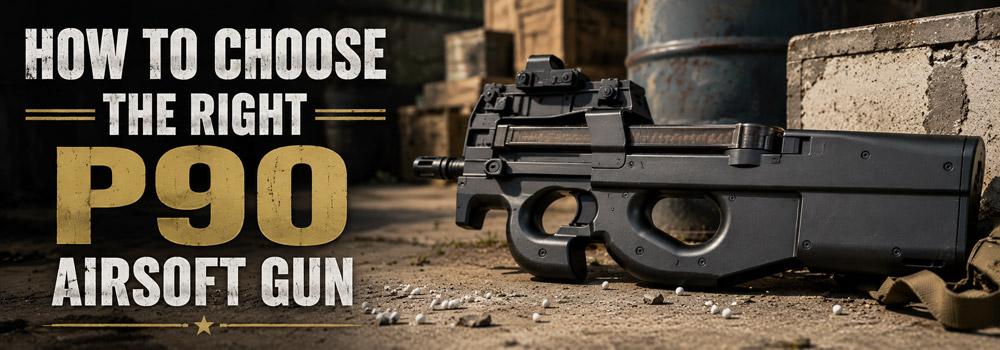
Four criteria determine which P90 fits your needs:
- Budget: you can get a Cheap electric P90 rifle for around £40-£50, but entry skirmish-level P90S start at about £120 to get you on the field, but expect to invest in upgrades. Mid-tier models (£200 to £300) balance cost and performance. Premium models above £450 deliver competition-ready internals, licensed bodies, and ETUs out of the box.
- Power system: AEGs maintain consistent performance across weather conditions, cost less per shot (electricity plus BBs only), and require less maintenance. GBBRs offer recoil feedback and realistic cycling but demand regular seal lubrication, more expensive magazines, and perform poorly below 10°C.
- Intended use ; For indoor CQB fields with velocity limits of 300 to 350 fps, a stock AEG P90 with standard springs works well. Outdoor or milsim use benefits from higher-energy spring setups, a longer barrel, and a tuned hop-up for accuracy at extended range, though the P90's maximum effective range in its real-steel form is 200 meters.
- Ergonomics: The P90's grip angle sits flatter and higher than a conventional assault rifle or pistol grip. The completely ambidextrous controls, including fire selector, charging handle, and magazine catch, work equally well for left- and right-handed users. The weapon's design keeps your hands within a man's shoulder width, improving manoeuvrability in tight spaces. If possible, handle a P90 before buying; the grip geometry feels unfamiliar to users accustomed to AR-pattern platforms.
Why was the P90 developed?
The P90 was created as a compact & powerful weapon for vehicle crews, support personnel, special forces, and counter-terrorist groups. Development of the rifle started in 1986, & production began in 1990. This is where the "90" in the name comes from. The design of the FN P90 is well-known for being entirely ambidextrous and for allowing right- or left-handed shooters to operate it with equal comfort. FN Herstal described it as the "first fully ambidextrous individual automatic weapon." The P90 su was designed to be no longer than a man's shoulder width to allow it to be easily carried & manoeuvred in tight spaces, such as inside an armoured vehicle or during CQB room clearance. To achieve the rifle's small size, the weapon uses an unusual bullpup configuration, in which the firearm's action and magazine are located behind the trigger.
Frequently Asked Questions
Are P90 airsoft guns good for beginners?
AEG P90s are suitable first guns, with some caveats. The top-loading magazine system requires a different reload technique than M4-pattern weapons. Magazine pouches need to be P90-specific. Aftermarket parts are less abundant than for the AR platform, though premium models from Krytac and Novritsch have improved parts availability. A mid-range AEG P90 with standard capacity magazines is the most beginner-friendly entry point.
What's the difference between P90 bb guns and regular submachine guns?
The FN P90 is classified as a personal defence weapon (PDW) rather than a standard submachine gun. It was developed between 1986 and 1990 by FN Herstal in response to NATO countries' requirements for a compact weapon capable of defeating soft body armour. The P90 entered service in 1990, fires the 5.7x28mm NATO calibre round from a 50-round magazine, and has a cyclic rate of fire of 900 rounds per minute. The weapon's design allows for ambidextrous use with downward ejection of spent casings, eliminating wasted space from a traditional side-ejection port. The bullpup design keeps barrel length competitive with carbines while the gun itself stays compact enough to be easily carried by vehicle crews and support personnel. The P90 was designed for rear echelon military troops; the primary goal was to provide non-combat specialists with a lightweight weapon. By 2009, the P90 was used by over 200 US law enforcement agencies, and in 1997, P90s were used in Operation Chavín de Huantar by special forces. The FN P90 is designed to minimise over-penetration compared to standard rifle rounds, reducing collateral damage in security operations. The PS90 was introduced in 2005 for civilian use, featuring a barrel length of 407 mm and a MIL-STD-1913 rail on top. In airsoft, replicas mirror this compact design and top-loading magazine layout, making them distinct from conventional submachine guns or airsoft pistols.
Do I need special gear for P90 magazines?
Yes. P90 airsoft magazines are flat, wide, and sit horizontally along the top of the receiver. Standard rifle or pistol magazine pouches will not accommodate them. Look for P90-specific MOLLE pouches or wide flap-style pouches that secure the magazine body without crushing the feed lips. A speed loader compatible with the P90's top-fill port also saves time on the field. High-capacity magazines benefit from a break-in period of cycling BBs through 5 to 10 times before first use.
Can P90 airsoft guns mount suppressors and other accessories?
The P90 TR model and premium airsoft replicas include Picatinny rail systems for optics, lasers, and lights. The P90 can mount tactical lights and laser aiming devices on side rails. Models like the Krytac Custom Edition include threaded outer barrels (14mm CCW) for mock suppressors. The real-steel P90 is compatible with the Gemtech SP90 suppressor, which reduces sound by 33 dB; airsoft suppressors serve primarily an aesthetic role or house longer inner barrels for improved accuracy. The P90 can also be fitted with a sling for easier carry during longer games. The P90 uses the MC-10-80 reflex sight on the real firearm, and airsoft versions accept most compact red dot or reflex sights on the top rail.
Shop P90 Airsoft Guns
The P90 platform delivers a compact design purpose-built for CQB airsoft. Whether you pick a budget AEG to start or a premium model with an ETU and precision barrel, the bullpup layout and top-loading magazines give you manoeuvrability that longer platforms cannot match in tight spaces. Browse the collection below and pick the P90 airsoft rifle that fits your play style and budget. if your looking for a bullpup rifle, also look at the popular L85 Rifle