Loading... Please wait...



















- Home
- Media Centre
- Violent Crime Reduction Act 2006
Violent Crime Reduction Act 2006 (UK) – Practical Guide for Airsoft and Imitation Firearms
Key Takeaways
-
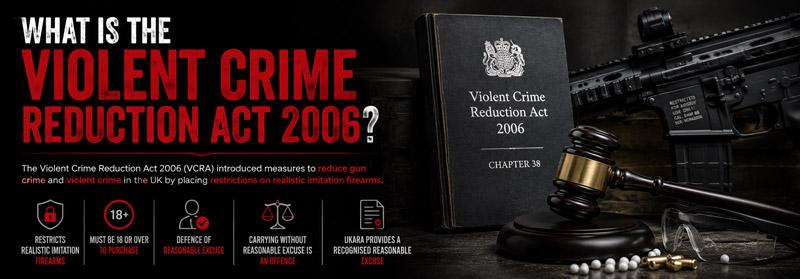
The Violent Crime Reduction Act 2006 is a UK Act of Parliament that tightens controls on realistic imitation firearms, air weapons, and introduces new firearms offences. It sits alongside the Firearms Act 1968, not replacing it.
-
Part 2 came into force mainly on 6 April 2007 and 1 October 2007. The core rule: it is generally an offence to manufacture, import, or sell a realistic imitation firearm.
-
Airsoft skirmishing is a recognised defence and has an exemption. Legitimate airsoft skirmishers can buy realistic airsoft replicas provided they play regularly at insured sites and can prove it through schemes like UKARA.
-
Players must be 18+, transport guns safely, and never brandish them in public. Airsoft retailers must verify age and defence eligibility of an airsoft player before any sale.
-
Official guidance: Home Office Guide on Firearms Licensing Law and the full VCRA text on legislation.gov.uk.
What is the Violent Crime Reduction Act 2006?
The Violent Crime Reduction Act 2006 is a UK law designed to tackle violent crime, alcohol-fueled disorder, weapon-related offenses, and anti-social behaviour. It received Royal Assent on 8 November 2006 and addresses anti-social behaviour and sexual offences alongside its weapons provisions. This article focuses on the firearms-related parts that matter most to airsoft players, retailers, and collectors.
The crime reduction act 2006 works alongside older firearms legislation-particularly the Firearms Act 1968-rather than replacing it. It introduces new firearms offences, extra controls on imitation firearms, and new penalties concerning the sale of knives and offensive weapons. Some provisions of the Act have been amended or repealed by later legislation, so always check the latest version.
The parts most relevant to weapons include Part 2 (Firearms), covering air weapons, realistic imitation firearms (airsoft guns), and offences relating to using others to mind weapons. Part 1 deals with alcohol-related disorder and is less relevant here, though it remains an important part of the wider act.
Key commencement dates: most firearms measures in Part 2 took effect on 6 April 2007, while the remaining provisions-including the main realistic imitation firearms rules-started on 1 October 2007 via a statutory instrument. The official wording and commencement orders can be read on legislation.gov.uk.
Core aims of the VCRA: reducing violent crime and misuse of weapons
The violent crime reduction act was passed to improve public safety by reducing access to weapons and cutting the misuse of firearms and imitation firearms on UK streets. Here are its main policy goals:
-
Making it harder for criminals to access realistic imitation firearms that look like a real firearm. Imitation firearms controls reduced their legal availability and misuse.
-
Tightening controls on air weapons and other low-powered guns, and creating new offences where people use others to hide or move guns or other missile-firing weapons.
-
The Act aims to prevent alcohol-related violence and disorder. It provided police with enhanced powers to address alcohol-related disorder, introduced Drinking Banning Orders prohibiting individuals from consuming alcohol in designated areas, and established Alcohol Disorder Zones allowing local authorities to charge licensed premises for policing costs if they contribute to disorder. It includes strong enforcement measures against underage alcohol sales and introduced measures to tackle alcohol-related violence with delegated responsibilities to licensed premises.
-
It aims to tackle weapon-related offences, including guns and knives. The legal age to purchase a knife was raised from 16 to 18, and the maximum penalty for possessing a knife in a public place without a good reason was doubled. The increased maximum penalty for possessing a knife in a public place reflected the seriousness of blade crime. The Act also established a mandatory minimum sentence for certain unlawful possession of prohibited firearms.
-
Police powers were expanded to allow searching school children for weapons, giving officers new tools to protect young people in school settings.
-
New tools were provided to reduce violent crime under the Act, though the Home Office assessment acknowledged limited direct evidence linking the Act to reductions in violent crime rates. Research suggests legislation alone has limited impact on serious violence without additional strategies.
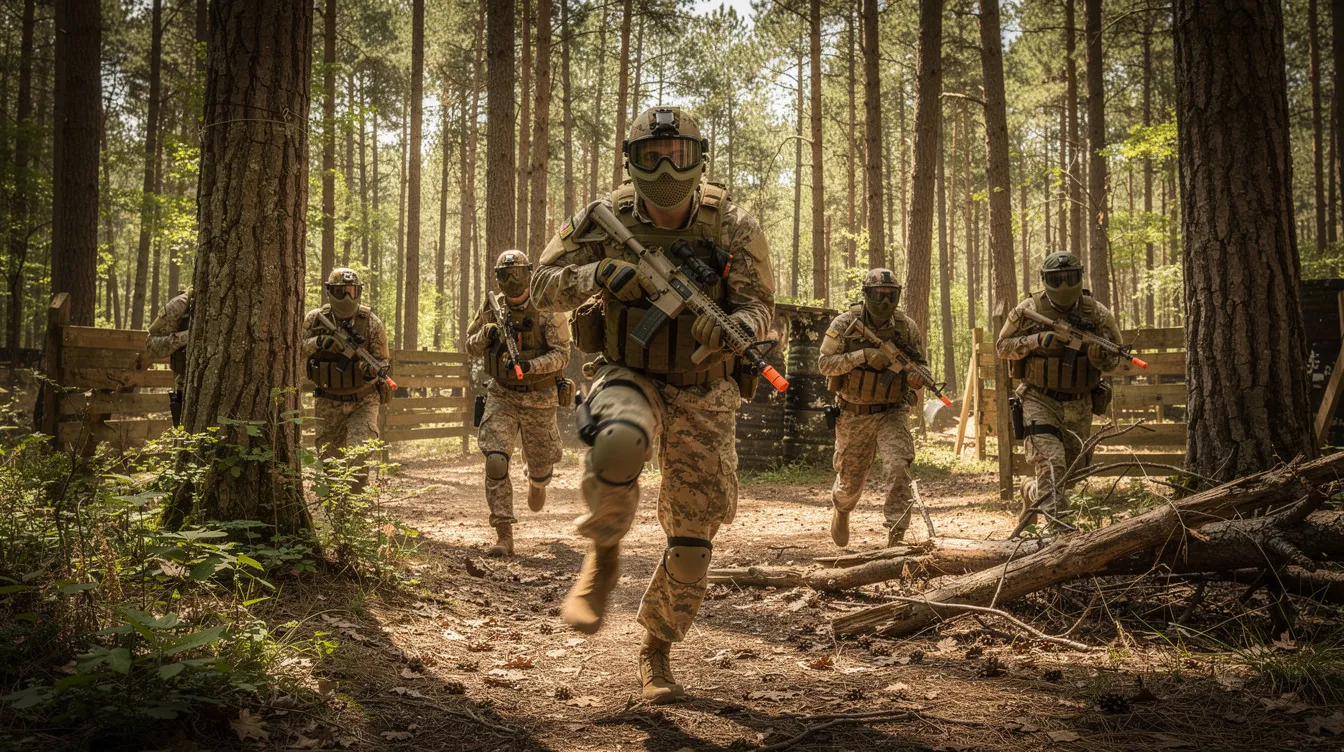
The Act has been credited with improving the legal framework for controlling weapons and alcohol-related disorder. Critically, it tries to balance public safety with permitted activities such as airsoft, historical re enactment, theatrical performances, museums, and film work-all of which receive specific defences. The violent crime reduction act does not criminalise responsible airsoft or shooting sports; it sets rules for how weapons and imitation firearms can be sold, possessed, and used lawfully.
Key definitions: imitation firearms, realistic imitation firearms and related terms
Understanding the definitions in the Act is essential because they determine what is and is not caught by the offences.
Imitation firearm – Under the Firearms Act 1968, an imitation firearm is any item that looks like a firearm, whether or not it is capable of firing a shot, bullet or other missile. An imitation firearm resembles a firearm but cannot discharge projectiles in the way a real one can. This can include toys and deactivated guns if they resemble real firearms.
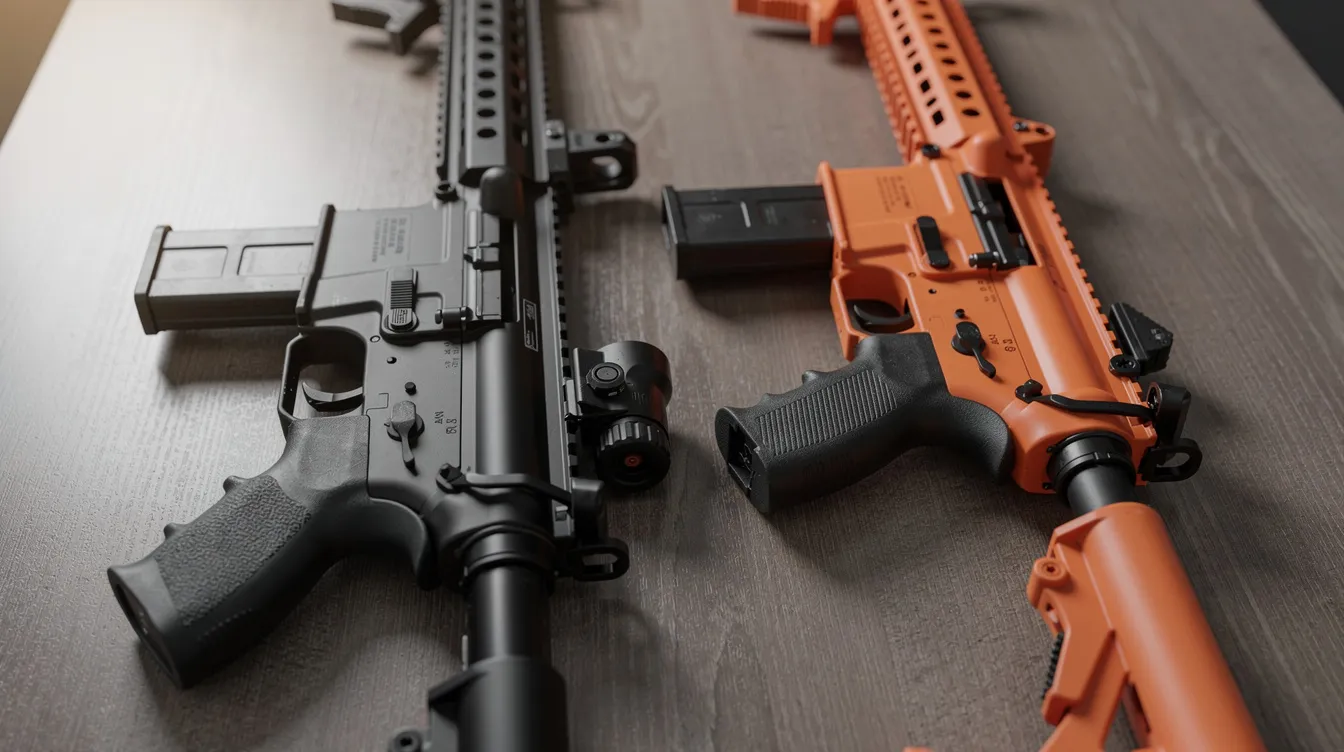
Realistic imitation firearm – Section 38 of the VCRA defines this more tightly. A realistic imitation firearm must appear indistinguishable from a real firearm to an ordinary person. Realistic imitation firearms are indistinguishable from real firearms. The test considers size, shape, and principal colour. The Realistic Imitation Firearms Regulations 2007 set specific thresholds: items under 38 mm height and 70 mm length are automatically "unrealistic," as are those in bright colours (red, orange, yellow, green, pink, purple, blue) or transparent materials.
Exclusions – Imitations of firearms made before around 1875 (antique-style designs) are exempt from VCRA requirements. Certain brightly coloured or transparent models are clearly not realistic. Fictional weapons are exempt from additional VCRA requirements as well.
Other key terms for practical purposes:
-
Air weapons – Air weapons are defined as air rifles, air guns, or air pistols powered by compressed gas, usually below specially dangerous thresholds.
-
Firearm – A firearm is defined as any lethal barrelled weapon under the Firearms Act 1968.
-
Component parts – Main parts of a lethal barrelled weapon (barrel, frame, receiver, cylinder) are controlled similarly to the whole gun.
-
Shot, bullet or other missile – The standard legal phrasing for what a weapon can fire.
Section 36 VCRA: offences for realistic imitation firearms
Section 36 of the violent crime reduction act 2006 is the main provision dealing with realistic imitation firearms. Manufacturing realistic imitation firearms is an offence under section 36 VCRA 2006.
The section makes it an offence to:
-
Manufacture a realistic imitation firearm
-
Modify an imitation firearm so it becomes a realistic imitation firearm
-
Import a realistic imitation firearm into Great Britain
-
Sell or otherwise transfer a realistic imitation firearm
These offences apply regardless of whether money changes hands. Gifting such items can still be caught. Manufacturing realistic imitation firearms is now illegal without a valid defence.
Maximum penalties are significant. Section 36 offences are triable either way, meaning cases can go before a magistrates' court or the crown court depending on seriousness. Under broader firearms law, possession of a firearm without a certificate carries up to 5 years' imprisonment, possession of a prohibited weapon can lead to a maximum of 10 years' imprisonment, and possession of a firearm with intent to endanger life can lead to life imprisonment. Carrying a firearm in public without lawful authority can result in 7 years' imprisonment.
Simple possession of a realistic imitation firearm by an adult in a private place is not in itself an offence under Section 36-but other laws covering conduct in public places, threatening behaviour, or public order still apply. There are specific statutory defences in Section 37 and related regulations for certain legitimate purposes, including airsoft skirmishing, covered below.
Statutory defences: museums, film, re-enactment and airsoft skirmishing
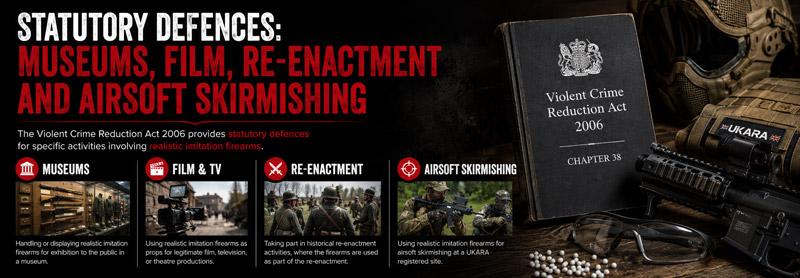
Section 37 of the VCRA and the Realistic Imitation Firearms Regulations 2007 set out defences to a Section 36 charge. These are not blanket permissions-anyone relying on a defence must show the person charged was acting only for one of the permitted activities.
The main categories where a defence may apply:
-
Museums and galleries – Acquiring realistic imitation firearms for public display, including items of scientific interest or historical significance.
-
Theatrical performances, film and television programmes – Using realistic imitation firearms as props in such performances and productions illustrating conduct in dramatic contexts.
-
Historical re enactment – Groups re enacting specific periods where realistic-looking weapons are required. Re enactors may use military vehicles, period uniforms, and replica weapons. These re enactment activities can also involve war veterans groups and similar organisations at a permitted event or other event held for that purpose.
-
Crown servants and related official purposes.
-
Arms fairs – Display at a permitted event such as arms fairs.
Anyone relying on a defence must show sufficient evidence that the realistic imitation firearm was made, imported, sold, or modified for the purpose of one of these activities. Many defences require appropriate third party liability insurance and a properly organised body. Sellers are expected to take reasonable steps to check that a buyer genuinely falls into one of the exempt categories and may ask for membership cards, letters, or registration numbers as proof.
The airsoft exemption under the VCRA
Airsoft skirmishing is specifically recognised in the VCR act framework and related regulations as a legitimate reason to buy and own realistic imitation firearms. This is the defence most relevant to the UK airsoft community.
How it works in principle:
-
A defence is available for the manufacture, import, and sale of realistic imitation firearms for use in permitted airsoft skirmishing activities.
-
Airsoft skirmishing must be carried out at properly organised, insured game sites like terminalsix.uk where players use imitation firearms AKA Airsoft guns to fire plastic BB pellets in controlled games. Each skirmishing event must be covered by public liability insurance.
Typical conditions from Home Office guidance and the 2007 Regulations:
-
Airsoft Games must be organised with third party liability insurance in place.
-
The airsoft site operator keeps records of regular players and can verify a member's entry in their system.
-
Participants use an airsoft gun that fires only small plastic pellets (≤ 6 mm diameter) below the energy thresholds set by Section 57A of the Firearms Act 1968: 1.3 joules for fully automatic and 2.5 joules for other types.
There is no single "official" registration scheme created by the Reduction Act itself, but trade bodies like the UK Airsoft Retailers Association (UKARA) have built registration systems. Airsoft retailers use these to cross-check that buyers are regular skirmishers. A British airsoft club or similar group at a UKARA-registered site typically requires new players to attend at least three games over roughly two months before registration. Individual airsoft players then receive a registration number. Once registered, legitimate airsoft skirmishers can lawfully buy realistic imitation firearms from participating retailers, who record the purchaser's details against the central database at the particular time of sale.
Realistic vs. non-realistic:
A "realistic imitation firearm" used in airsoft (such as a black replica rifle) requires the airsoft defence for purchase. A non-realistic airsoft gun-one in a bright principal colour like orange or blue-can usually be bought by an adult without using the airsoft exemption because it falls outside the VCRA's realistic test. Buyers of exempt firearms must be over 18 years old regardless.
Age limits and rules on supplying imitation firearms
The Act prohibits the sale of certain weapons to minors, and there are strict age-related offences for supplying imitation firearms under the crime reduction act, separate from the airsoft exemption.
Main age rules:
-
Individuals or airsoft players under 18 cannot purchase imitation firearms, whether realistic or not.
-
It is an offence to sell an imitation firearm to anyone under 18.
-
Half weapons and similar items also require buyers to be over 18 years old.
-
Similar rules apply to realistic imitation firearms on top of the extra Section 36 controls.
The definition of "imitation firearm" here is the wider Firearms Act 1968 version, so even brightly coloured toys that clearly look like guns can be caught by the age restriction.
For most airsoft purchases, the buyer must be at least 18. Airsoft Retailers should carry out age-verification photo ID checks for in-person sales and robust checks for online non face to face sales. Offences also cover giving an imitation firearm to a person under 18 in some circumstances, so adults should think carefully before gifting such items to school children or other minors.
These age rules apply to imitation firearms broadly, not just to the more tightly controlled realistic imitation firearms.
Air weapons, component parts and other key firearms measures in the Act
The violent crime reduction act 2006 also brought in several important rules about air weapons and related firearms offences, beyond the imitation firearms provisions.
Sales and transfer of air weapons:
Air weapons must be sold in person to buyers. Commercial sellers of air weapons sold through trade must normally be a registered firearms dealer with the police. Sales of air weapons (including some component parts and silencers/moderators) must usually be done face-to-face-no simple mail-order delivery to the customer's door. Dealers must register transactions involving air weapons, and antique air weapons manufactured before 1939 are exempt from registration.
Firing an air weapon beyond premises:
A new offence exists for firing air weapons beyond premises. If a pellet leaves the boundaries of the land where the shooter is allowed to shoot, an offence relating to that conduct has been committed. This applies regardless of age, and adults supervising young people can also be liable if they allow unsafe use.
Using someone to mind a weapon (Section 28):
It is an offence to arrange for another person to store, transport, or "mind" a firearm, certain air weapon component parts, or prohibited weapons with intent to make them unlawfully available. This targets people who try to distance themselves from weapons by leaving them with associates, and any parties arising from such arrangements can face prosecution.
Component parts and ammunition:
Modern amendments to firearms law treat key component parts of lethal barrelled weapons much like the weapons themselves. Anyone dealing in parts, ammunition, or accessories should consult the latest Home Office firearms guidance for details, as the laws around such items can be technical.
Practical guidance for airsoft players, skirmish sites and retailers
Here is straightforward "do and don't" guidance for anyone involved in UK airsoft.
For airsoft players:
-
Join a reputable, insured skirmish site and become a regular player before buying realistic imitation firearms. Attend games and build up your record so you can rely on the airsoft defence with confidence.
-
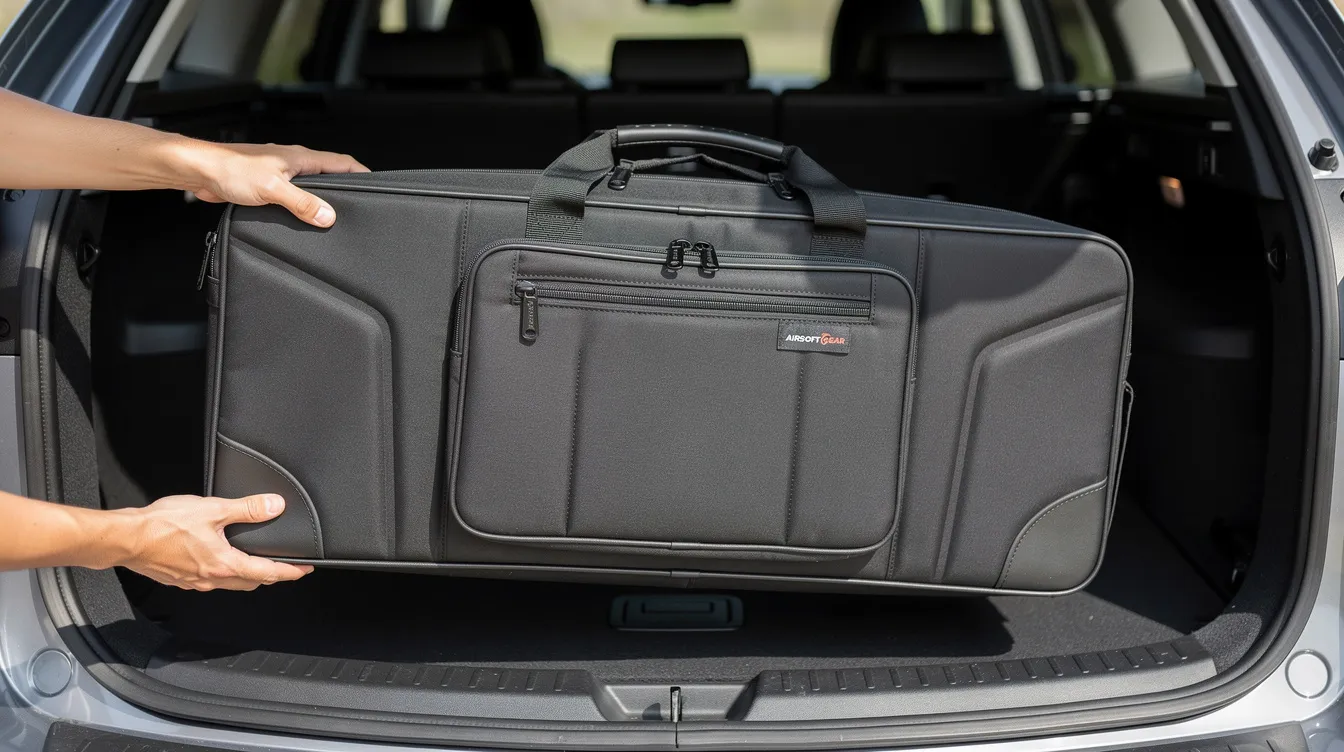
Transport guns safely: carry them unloaded, in a secure bag or case, go directly to and from a site or safe storage, and never brandish them in public. A reasonable excuse for having an imitation firearm in a public place means going directly to or from a game-nothing more.
For site operators:
-
Keep accurate records of regular players to help them rely on the airsoft exemption. Sign-in logs, membership databases, and proper record-keeping for each member's entry all help.
-
Maintain suitable public liability insurance and clear site rules covering eye protection, safe zones, and safe handling of air weapons and airsoft guns.
For retailers:
-
Check age (18+) and, where selling realistic imitation firearms, verify a valid defence. This applies whether the buyer cites airsoft skirmishing, museum use, film/theatre, or historical re enactment.
-
Use schemes like UKARA or equivalent to confirm player eligibility. Keep transaction records that show why a defence applies-retailer-held logs of the purchaser's details and date of sale are essential.
Check the latest official Home Office firearms guidance and local police forces' firearms licensing pages regularly, since rules on air weapons, component parts, and related weapons can change over time. For practical purposes, staying informed is part of staying legal.
Official resources and where to get up-to-date guidance
Firearms law develops over time. Always check current official guidance before acting on anything in this article. Some provisions of the reduction act 2006 have already been amended, and further changes are possible.
Key resources:
-
Full text of the Violent Crime Reduction Act 2006 – legislation.gov.uk
-
Guide on Firearms Licensing Law – Home Office, GOV.UK
-
CPS Prosecution Guidance on Firearms – Crown Prosecution Service
These documents help different audiences. Airsoft Players and hobbyists can check high-level rules on airsoft guns, air weapons, and imitation firearms. Airsoft Retailers and site operators can confirm their obligations on record-keeping, age checks, and what counts as a realistic imitation firearm. Anyone unsure about an offence relating to component parts or unusual weapons can see how they are classified.
Where there is any doubt, contact your local police firearms licensing unit or seek independent legal advice. Enforcement practice can vary between police forces, and a quick conversation can prevent an unwitting offence.
Frequently Asked Questions
Below are answers to common questions not fully covered in the main article. These are intended as general guidance-not legal advice.
Does the Violent Crime Reduction Act 2006 ban airsoft in the UK?
No. The violent crime reduction act does not ban airsoft in the uk. It controls how realistic imitation firearms are made, imported, and sold, and provides an exemption for properly organised and insured airsoft skirmishing. As long as airsoft players, sites, and airsoft retailers shops follow the rules on age limits, defences, and safe use, airsoft remains a perfectly legal hobby across the UK. The Act aimed to reduce street crime involving realistic-looking weapons, not to shut down legitimate sporting activities.
Do I need a firearms certificate to own an airsoft gun or realistic imitation firearm?
Most standard airsoft guns fall below the power thresholds in Section 57A of the Firearms Act 1968 (1.3 joules for automatic, 2.5 joules for semi-auto or single-shot), so a firearms certificate is not usually required in Great Britain. However, this does not remove VCRA requirements-realistic imitation firearms are still controlled by the Section 36 regime, and players must rely on defences like the airsoft exemption for the purchase of such items. If you use unusually powerful gas or HPA-driven setups that might approach firearm power levels, check official guidance or speak to local police to confirm your provision falls within legal limits.
Can I paint my bright-coloured airsoft gun to make it look more realistic?
Repainting a non-realistic airsoft gun (for example, from bright orange to black) can turn it into a realistic imitation firearm under the VCRA tests. If a person without a valid defence under the Act carries out that modification, they may be committing an offence similar to manufacturing a realistic imitation firearm. Only carry out such cosmetic changes if you can clearly rely on a defence-for example, you are a regular airsoft skirmisher with a UKARA registration or equivalent. Even then, follow all transport and public-place rules for the date of any game or event held afterwards.
Is it legal to carry a realistic imitation firearm in public on the way to a game?
UK laws under the Firearms Act 1968 make it illegal to carry a firearm or imitation firearm in a public place without lawful authority or reasonable excuse. Travelling directly to or from an insured airsoft site with the gun properly covered, unloaded, and stored-for example, in a gun bag in a car boot-can count as a reasonable excuse. Waving or displaying it in public almost certainly will not. Keep guns concealed at all times, avoid public transport where possible, and be prepared to explain your reason calmly if spoken to by police.
How does the law treat component parts and accessories like silencers?
Key component parts of firearms (barrels, frames, receivers) are often treated in law much like complete firearms, and some moderators or suppressors for air weapons are controlled when air weapons sold commercially fall under VCRA provisions. Simple cosmetic parts-rail covers, grips, and similar-are usually not controlled in the same way. However, the exceptions and classifications can be technical, so players and retailers should always check official Home Office guidance. Where there is any doubt about whether a component part or accessory falls under firearms offences, specialist legal advice or confirmation from your local police firearms unit should be sought before any sale or purchase.